

Selection beyond the mainstream
Capital is increasingly concentrated among the largest managers. Among smaller specialists, the wide dispersion of outcomes makes careful selection essential.
For professional clients and eligible counterparties only
Hedge fund assets are at record levels, but this year’s net inflows have clustered among the largest firms. Smaller specialist managers are raising very little, and the difference between the best and worst of them is large. For allocators, that is a reason to look harder at selection, not to avoid the segment.
Most institutional manager line-ups look much the same. The large multi-strategy platforms and flagship buyout franchises appear on nearly every consultant buy list, and they earn their place: deep operational infrastructure, long track records and the capacity to absorb a meaningful ticket. They are also the easiest choice to defend at board level.
The difficulty is that scale and skill are not the same thing. Many capable investors run smaller, specialist firms, where results are far more uneven. Some funds do exceptionally well and others fall short. That range is what gives careful selection its value.
Capital is concentrating at the top. Firms below $1 billion attracted less than 3% of new hedge fund capital in the first half of 2026. Outcomes are widely spread, particularly among smaller managers, so which fund you hold matters far more than the category average. Access is the constraint. Finding the strongest of them takes coverage, time and relationships that few allocators can maintain in-house.
Allocations are concentrating at the top
Investors deployed almost $90 billion into hedge funds in the first half of 2026. Firms managing more than $5 billion took 86% of it, while managers below $1 billion took less than 3%.1 Private equity is following the same path. Funds of more than $5 billion raised 35% of global buyout and growth capital in 2025, compared with 28% in 2021.2
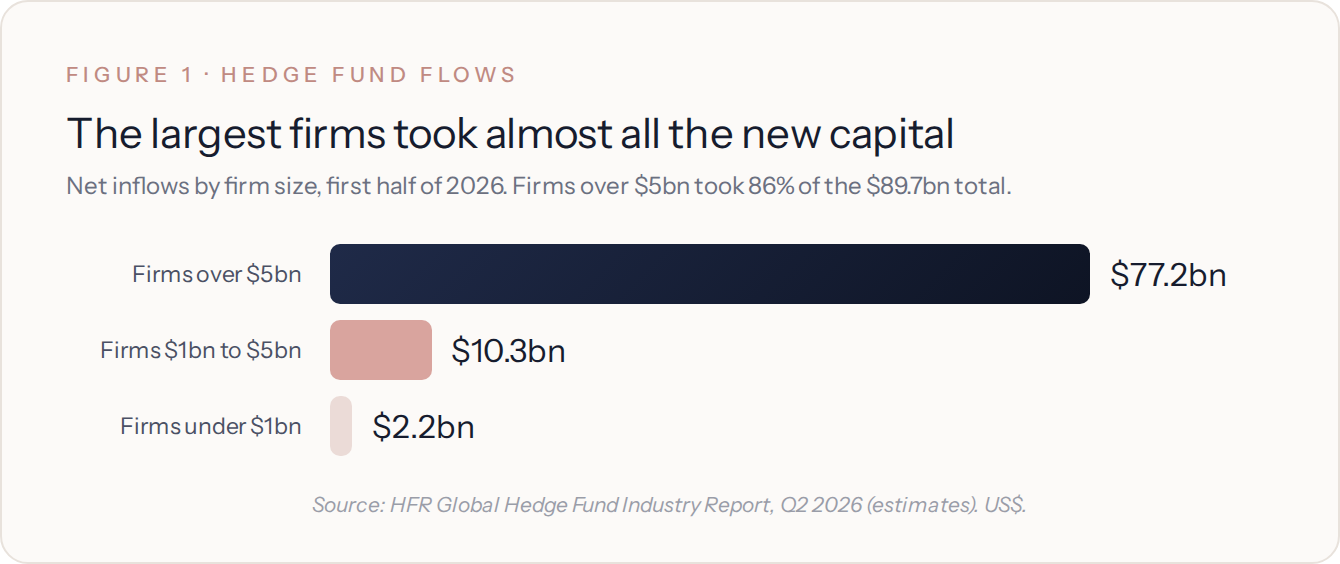
Flows like these reflect what is easiest to get through an investment committee. They are a much weaker guide to where future returns will come from.
What scale does to a strategy
Every strategy has a capacity limit. A manager trading small caps, niche credit or less liquid markets can be nimble while assets are modest. As the fund grows, the positions that built the track record become harder to enter and exit without moving prices, so the portfolio migrates towards larger, more crowded trades and returns begin to resemble the market. The economics change as well. Once management fees alone support a comfortable business, the incentive to protect performance can give way to an incentive to protect assets.
Recent research from Man Group on systematic equity managers supports this. During the 2018 to 2020 quant winter, the largest managers became disproportionately reliant on generic, widely used factors, and that reliance has persisted since. The authors read this as evidence that scale pushes managers towards crowded, high-capacity positions.3
That does not mean small managers win every year. PivotalPath’s data showed hedge funds under $500 million ahead of their larger peers through November 2025, having trailed them in 2024.4 The size advantage is real but cyclical, and buying small managers as a category is not a dependable way to capture it.
Why the average misleads
In 2025, the top decile of funds in the HFRI Fund Weighted Composite Index returned an average of 62.7%. The bottom decile lost 12.8%.5 The 12 months to August 2026 produced almost exactly the same spread.6 On paper, two investors could have held identical hedge fund allocations and had entirely different years. What decided the outcome was which managers sat behind the allocation.
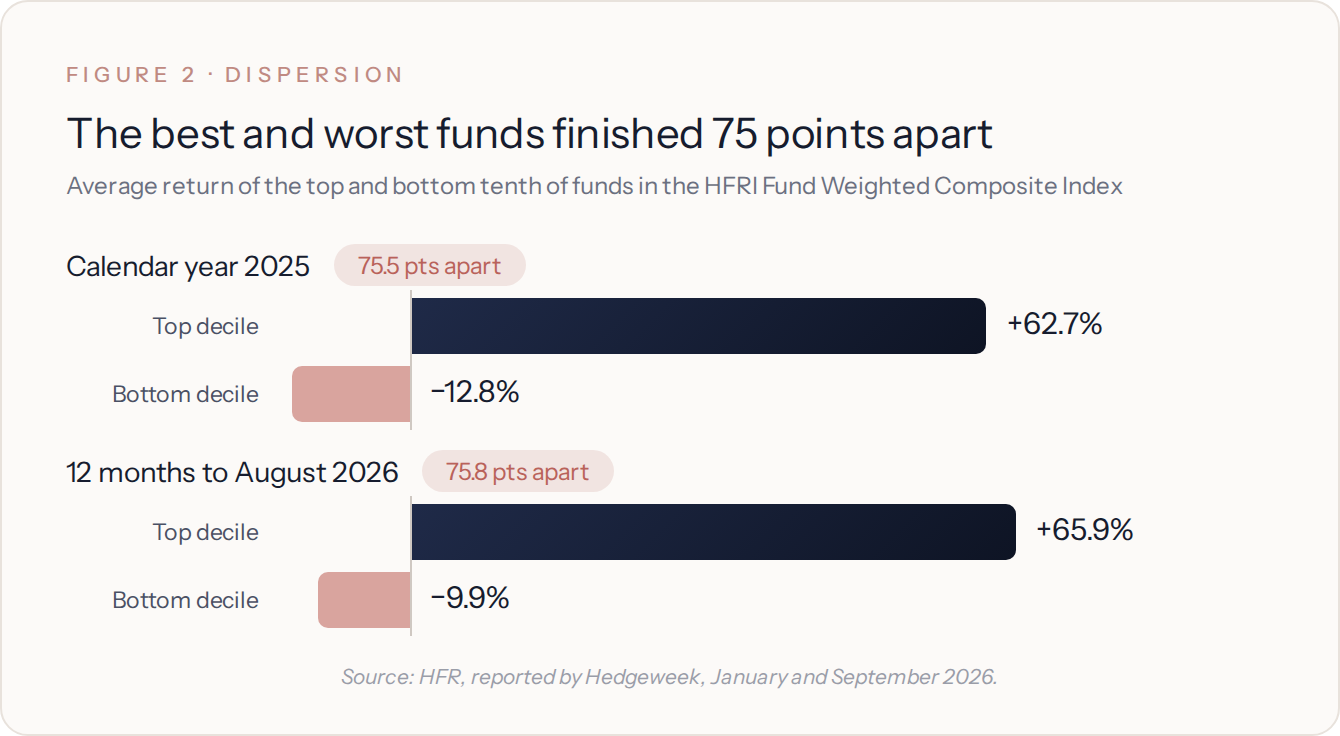
The spread is still wider among smaller managers. J.P. Morgan Asset Management found that the best-performing buyout funds below $5 billion have consistently outperformed their larger counterparts by around 5%, and that returns at the smaller end are more dispersed.7 That follows from how small funds are built. Portfolios are more concentrated and outcomes rest on the judgement of a handful of people, which is a genuine advantage when those people are good and a serious problem when they are not. There is also a survivorship issue. Small funds that close usually stop reporting to databases, so published averages for the segment tend to flatter what investors actually experienced.
McKinsey’s figures suggest that specialism matters more than size alone. Across buyout funds of the 2010 to 2022 vintages, specialists delivered IRRs of 17% against 13% for generalists, and depended far less on rising valuations to get there: multiple expansion accounted for only 5% of the value they created, compared with 35% for generalists.2 The opportunity is in identifying specialists at the top of that range. Being small is not, by itself, a reason to invest.
How we tell them apart
Our diligence starts with what drives the returns rather than with the headline track record. Four questions do most of the work. What does this manager do better than its competitors, and where does its opportunity set come from? How much of past performance came from leverage, market beta or rising valuations? What happens to the portfolio when the base case is wrong? And has the strategy become harder to run as assets have grown?
Operational standards cannot be scaled down for a smaller firm. We expect independent administration, a reputable auditor and robust valuation policies, with outsourced providers verified rather than taken on trust.
Alignment takes more digging. How much of their own capital have the principals committed? How would the business cope with a difficult year or the loss of a key person? A track record rarely answers those questions. Time spent with the team usually does.
Timing matters too. The best smaller managers often have limited capacity, and much of it goes to investors who commit early, sometimes through founders’ share classes with reduced fees. By the time a manager appears on most consultant lists, the best terms, and often the capacity itself, have gone. Covering this part of the market properly means screening thousands of funds and meeting managers well before they become widely known, which is beyond the resources of most allocators.
Where this leaves allocators
The largest managers will continue to earn their place in many portfolios. An allocator who never looks beyond them, however, is choosing only from the most crowded part of the market and giving up the part of the return distribution where selection pays most.
Our view is that some of the most sophisticated investors in the industry run smaller, specialist businesses outside the mainstream, and that their focus, alignment and independence from the broader market give them the potential to perform across different environments. Because outcomes among these managers vary so widely, the value lies in choosing well. That is where we spend our time: finding and assessing these managers, and introducing allocators only to those we believe sit at the top of the range.
Looking beyond the usual names?
Start the conversationSources
- HFR, “Hedge Fund Industry Asset Growth Shatters Records”, HFR Global Hedge Fund Industry Report Q2 2026, press release, 23 July 2026. ↩
- McKinsey & Company, “Private equity: Clearer view, tougher terrain”, Global Private Markets Report 2026, February 2026. ↩
- Xiang, V. and Ben-Akiva, O., “The Quant Renaissance Part III: Who’s Ready for the Next Winter?”, Man Group, 2026. ↩
- PivotalPath data, reported in Morrell, A., “Why small hedge funds ruled in 2025”, Business Insider, December 2025. ↩
- HFR data, reported in Hedgeweek, “Hedge funds post strongest annual gains since 2009, says HFR”, 9 January 2026. ↩
- HFR data, reported in Hedgeweek, “Macro hedge funds lead August rebound as commodities and CTAs surge”, 9 September 2026. ↩
- Jayroe, T., “A big role for small and middle-market private equity investments”, J.P. Morgan Asset Management, 20 August 2026. ↩
This piece is for information purposes only and does not constitute investment advice. Past performance is not a reliable indicator of future results.